
What it is
A free-flow junction with a computer inside
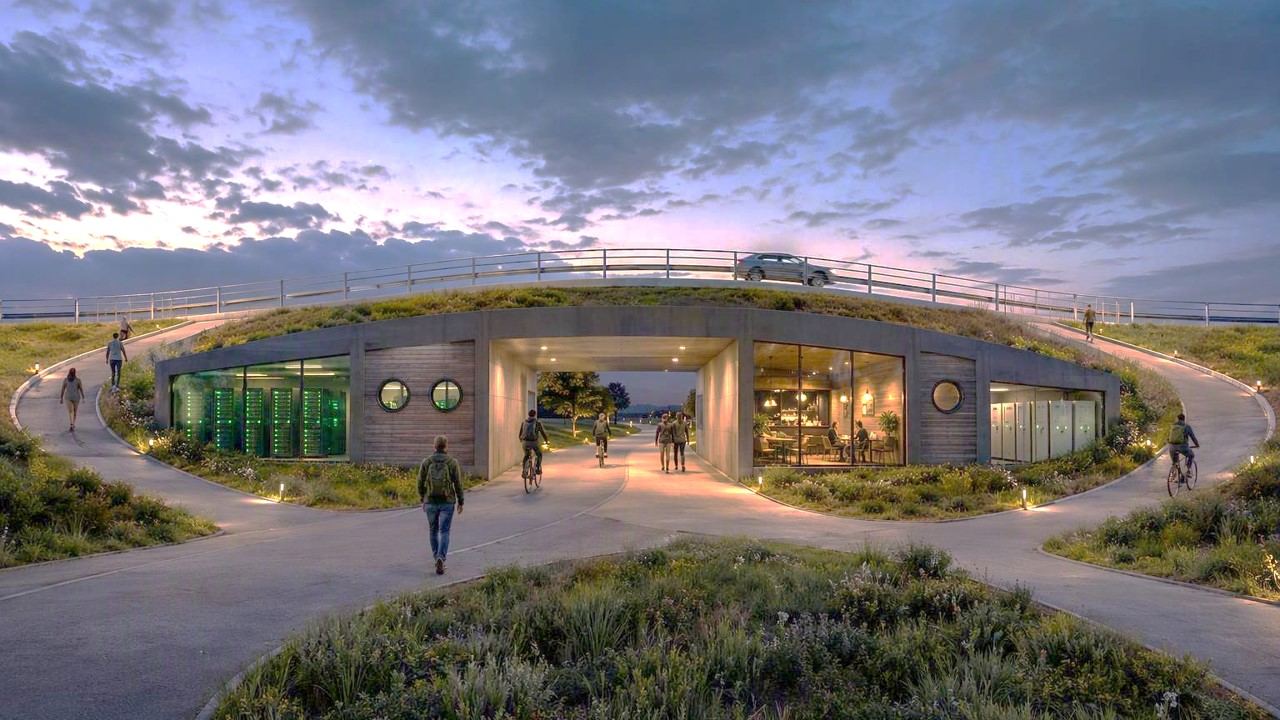
The solution to a physical problem has to be physical. Umpireal raises the road about 2.5 metres and drops the walking and cycling route about 1.5 metres. Traffic flows over the top with no traffic lights. People pass underneath in daylight, not in a subway. And the rooms created between the two levels, the Innerspace, hold an Urban Computer.
What it is not
- Not a traffic app or signal optimisation
- Not a routing algorithm
- Not dependent on driver behaviour
- Not a congestion charge
- Not road widening
What it is
- A digital free-flow junction or crossing
- Momentum kept by geometry
- AI inference compute close to demand
- Battery storage, EV charging and heat
- An asset that pays for the junction
Why it works
Four things at once
Removes the stop
Grade separation and free-flow geometry take the conflict out of the junction, so the momentum tax never starts, whatever the vehicle runs on.
Compute where demand lives
AI is shifting to inference, which works best close to the people and machines using it. The node puts 1 to 20 MW of it in the town itself, on a local connection.
Supports the grid
Battery storage at the edge of the network, where the evening peak forms, is designed to support the local grid rather than only draw from it.
Pays for itself
Colocation rent from the compute funds the junction, on land already set aside for the road, with no public capital asked.
Every component, from precast concrete to liquid cooling and battery storage, is in use today, and so are the construction methods. What is new is putting them together in the road.
Where we are
Status and partners
Umpireal has a patent application filed in Ireland, IE 2025/0540, with a PCT application in progress. The precast shell has been tendered, cooling validated with Asperitas, and a council letter of interest received with no public capital asked. We have been accepted into NVIDIA Inception, AWS Activate and the Google for Startups Cloud Program. The first node is in preparation.
Developers and councils
The access junction a scheme needs anyway, turned into a funded, free-flow asset.
Compute buyers
Colocation for inference, agents, fine-tuning and sovereign capacity, close to users.
Infrastructure investors
Long-life assets with a 100-year design life, held in node SPVs.
Energy partners
Battery storage and EV charging on a site that is already consented as part of the road.
Insurers
A stake in removing the conflict points behind junction claims.
Team
Engineers, designers and operators who want to build the standard for the next generation of towns.