
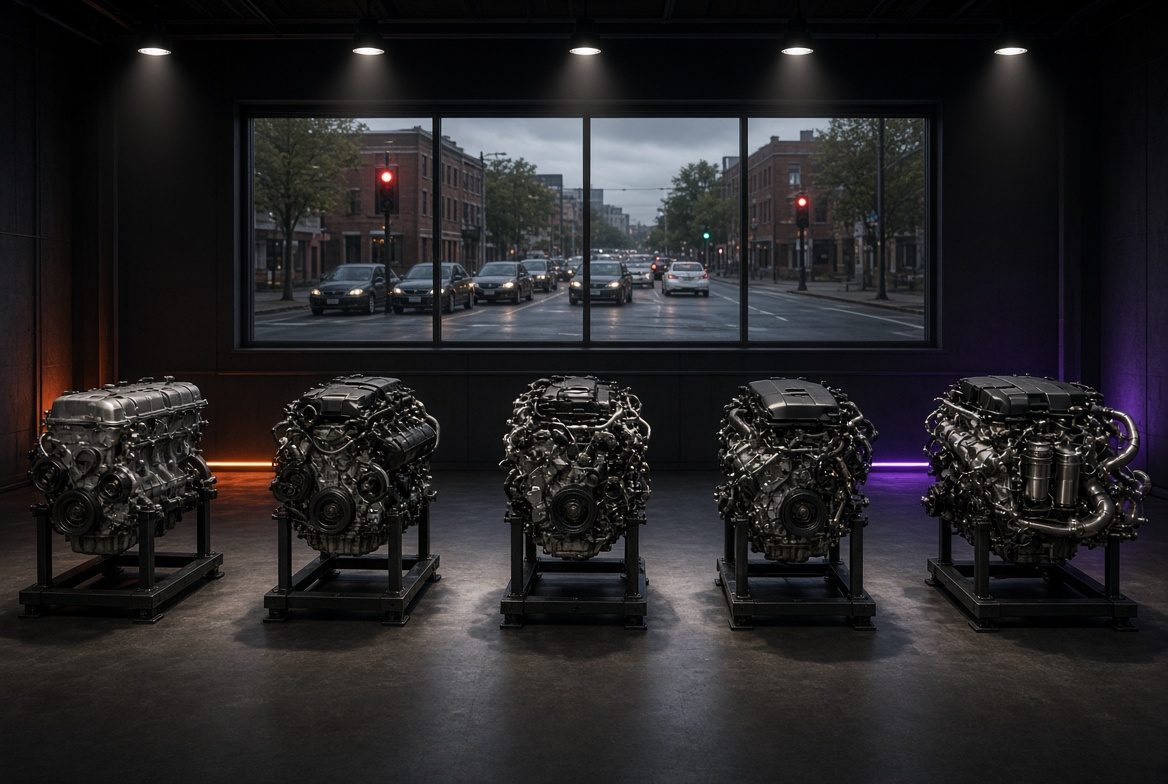
Three decades of engine policy
The standards that cleaned the engine
From 1992, Europe ran one of the most ambitious regulatory programmes in industrial history. The Euro emissions standards became a global template: the US followed with its EPA Tier standards, India with Bharat Stage, China with China VI. All shared one premise: regulate the engine as the main source of harm.
The results were real. Permitted levels of nitrogen oxides and particulates have fallen by around 80 to 95% since the early 1990s. That should not be understated. But it is only half the story.
- 1992: Euro 1First limits on CO, hydrocarbons, NOx and particulates. Catalytic converters become standard. Road infrastructure: unchanged.
- 2001: Euro 3Separate particulate and NOx limits; exhaust gas recirculation spreads. Road infrastructure: unchanged.
- 2011: Euro 5Diesel particulate filters become mandatory, and struggle in stop-start urban driving. Road infrastructure: unchanged.
- 2015: Euro 6Selective catalytic reduction, AdBlue and advanced sensors; Dieselgate exposes compliance workarounds. Road infrastructure: unchanged.
- 2026: Euro 7Adopted in 2024 and applying from late 2026, adding brake dust and tyre particulates. Road infrastructure: still unchanged.
Thirty years of regulation targeted the engine. Not once did policy ask how many times the road forces that engine to start again from zero.
The flaw in the framework
Cleaning combustion is not reducing it
Emissions standards were designed to clean combustion, to cut the harmful by-products of burning fuel. They were never designed to cut how much fuel is burned. That distinction is the limit of three decades of effort.
The CO₂ produced by burning a litre of fuel depends on its carbon content, not on how advanced the engine is. Cleaner combustion does not mean less combustion.
The missing standard
Europe has a standard for engines. It has none for roads.
A meaningful infrastructure efficiency standard would measure how much of the energy put into a road network is kept as useful forward motion, and how much is destroyed by forced stopping and restarting. No such measure exists. No target has ever been set. This is the gap Umpireal is designed to fill.