
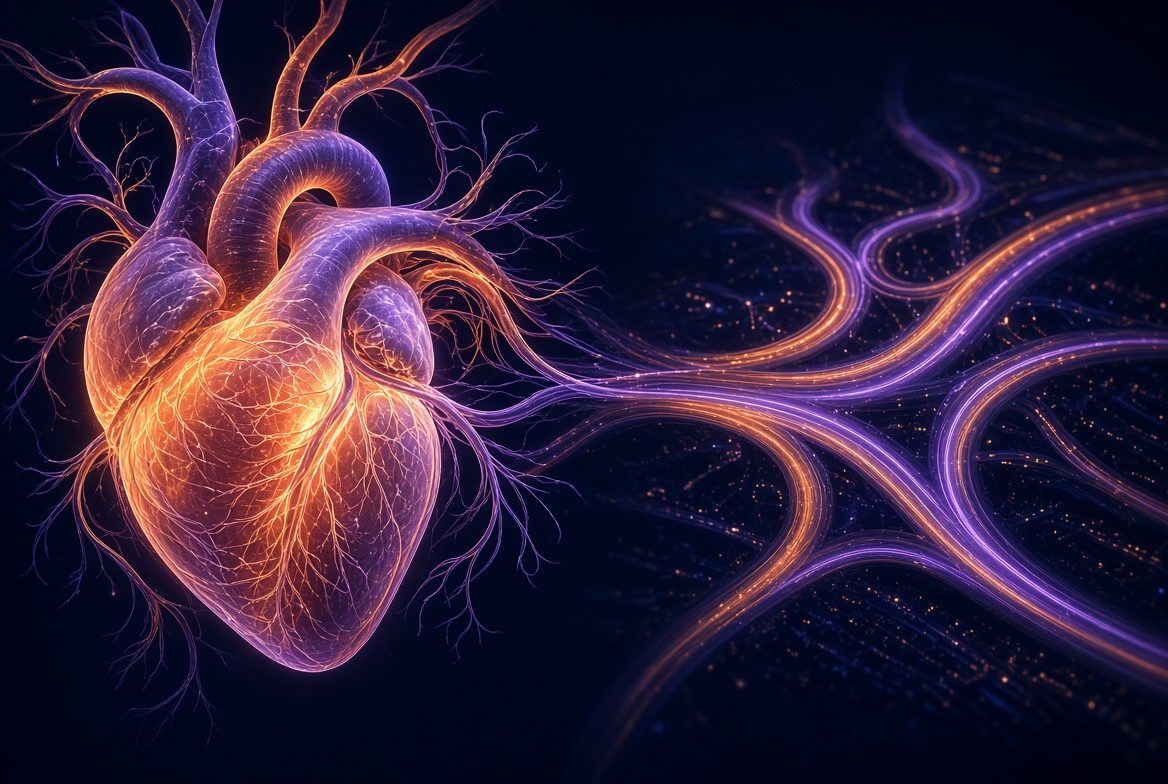
Nature’s flow model
Your heart never stops. Why does traffic?
The circulatory system is nature’s most successful continuous-flow network. It runs without stopping for eight or nine decades, carries several streams without conflict, and keeps flow moving through geometry rather than enforcement. It has never needed a traffic signal.
Blood flow
- Continuous pulsed flow, never fully stopped
- Two separated streams, arterial and venous
- Flow regulated by geometry, not signals
- Pressure differences keep everything moving
- Interruption is treated as failure
Traffic flow
- Interrupted by design, with stops at intervals
- Conflicting streams share the same space
- Signals and enforcement at every node
- Momentum destroyed and bought back again
- Interruption is treated as normal
Road networks should keep momentum through continuous flow and separation, just as nature always has.
Four principles nature has always known
What roads can learn from biology
The cardiovascular system did not arrive at its design through regulation. It evolved under physical constraints, the same constraints that apply to roads. Its principles are not biological curiosities. They are engineering rules.
01 Continuous flow
The heart pumps continuously. Energy is never deliberately thrown away, and traffic infrastructure can work the same way.
02 Separated streams
Arteries and veins never share a channel. Incompatible flows are separated by design, while roads force cars, bikes, people and freight to compete.
03 Geometry sets the speed
Vessel size, branching angles and pressure control the flow, with no signals and no enforcement.
04 Interruption is failure
In the body, stopped flow is an emergency, and the system is built so it does not happen in normal conditions.
The design principle
From biology to the junction
Umpireal applies these four principles directly to junctions and crossings: geometry sets a calm, steady speed, road users are separated by level, and the need for enforced stops is designed out. Momentum is kept, not destroyed.