
The first tax
How the State taxes the tax
In Ireland, as in most of Europe, motorists do not pay a single fuel tax. They pay excise duty and carbon tax, then levies, and then VAT is applied on top of all of them. When pump prices rise, VAT revenue rises automatically with them.
| Component | € per litre | Share |
|---|---|---|
| Fuel, refining and distribution | ~€0.84 | ~40% |
| Excise duty and carbon tax | ~€0.75 | ~36% |
| Other levies, including NORA | ~€0.12 | ~6% |
| VAT at 23%, charged on top of the taxes | ~€0.39 | ~19% |
| Total at the pump | €2.10 | 100% |
| Total government take | ~€1.26 | ~60% |
Illustrative breakdown at a €2.10 pump price. Rates differ between petrol and diesel and change with each budget; figures are rounded.
The forecourt keeps only a few cents a litre to cover wages, power, rent and insurance. A rising pump price is not retail profit. It is compounding taxation.
The second tax
The tax the road collects
Global oil markets rise and fall, yet energy keeps feeling expensive. One reason is structural: in many electricity markets the price is set by the most expensive generator, often gas, so even cheap renewable power is sold at fossil prices when gas surges.
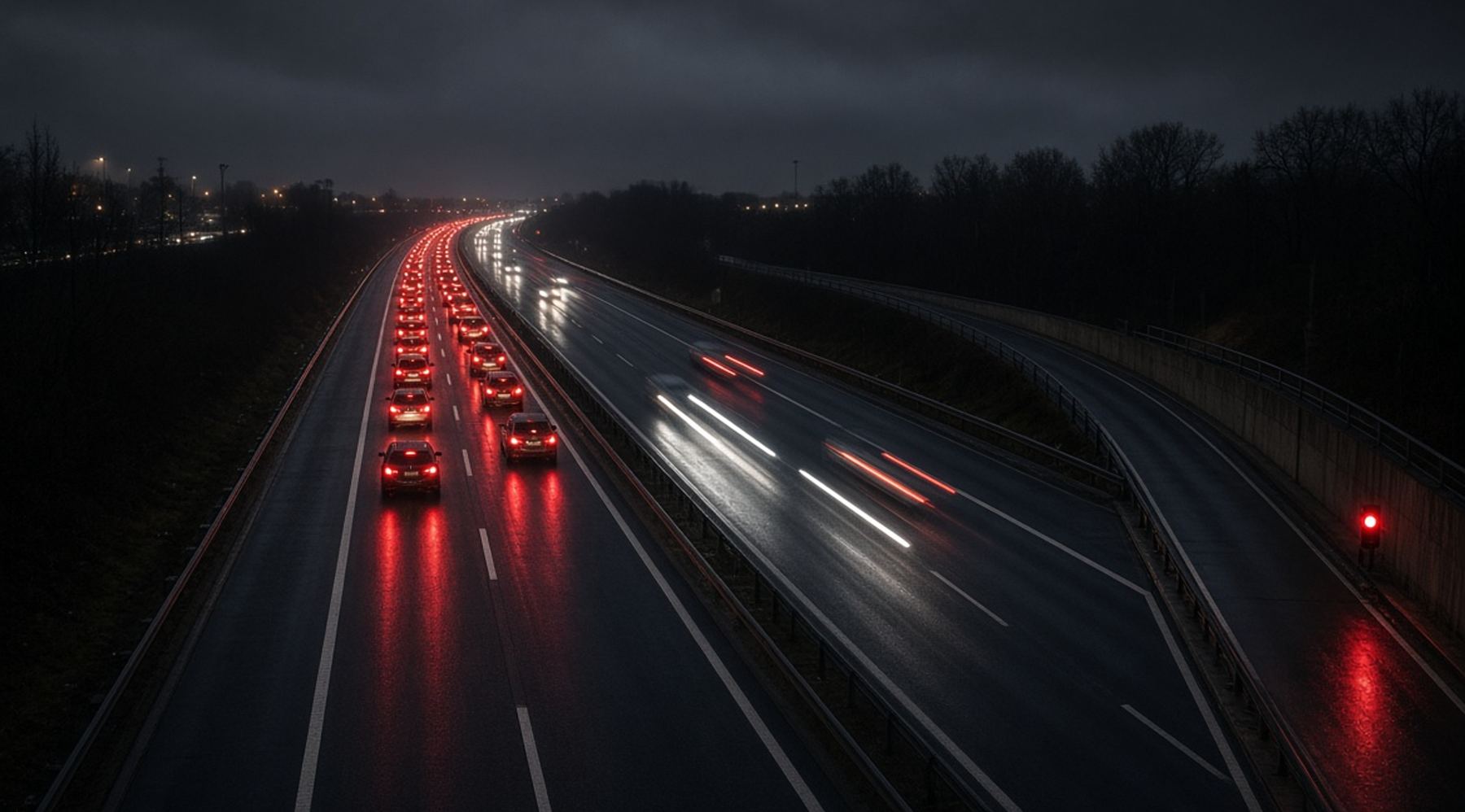
The second reason is on the road. Every junction, signalised crossing and speed bump forces a vehicle to throw away momentum it has already paid for, then buy it back again at 12 to 20% engine efficiency, the engine’s worst operating band.
- Fuel boughtTaxed once, then taxed again through VAT.
- Speed paid forThe fuel becomes kinetic energy: the vehicle’s momentum.
- StopThe junction turns that momentum into brake heat.
- Buy it againThe vehicle re-accelerates at its least efficient, paying for the same speed twice.
The real issue is not the price of fuel. It is the number of ways energy is drained away before it does any useful work.
The conclusion
Two taxes, one fix
Tax at the pump is visible and debated. The infrastructure tax is invisible, uncollected and unlimited. Together they inflate costs, erode productivity and undermine the efficiency of every town, whether its vehicles run on fossil fuel or electricity.
Improving the engine helps. But however efficient an engine becomes, a road network designed to destroy momentum repeatedly wastes much of that efficiency before it does useful work.