
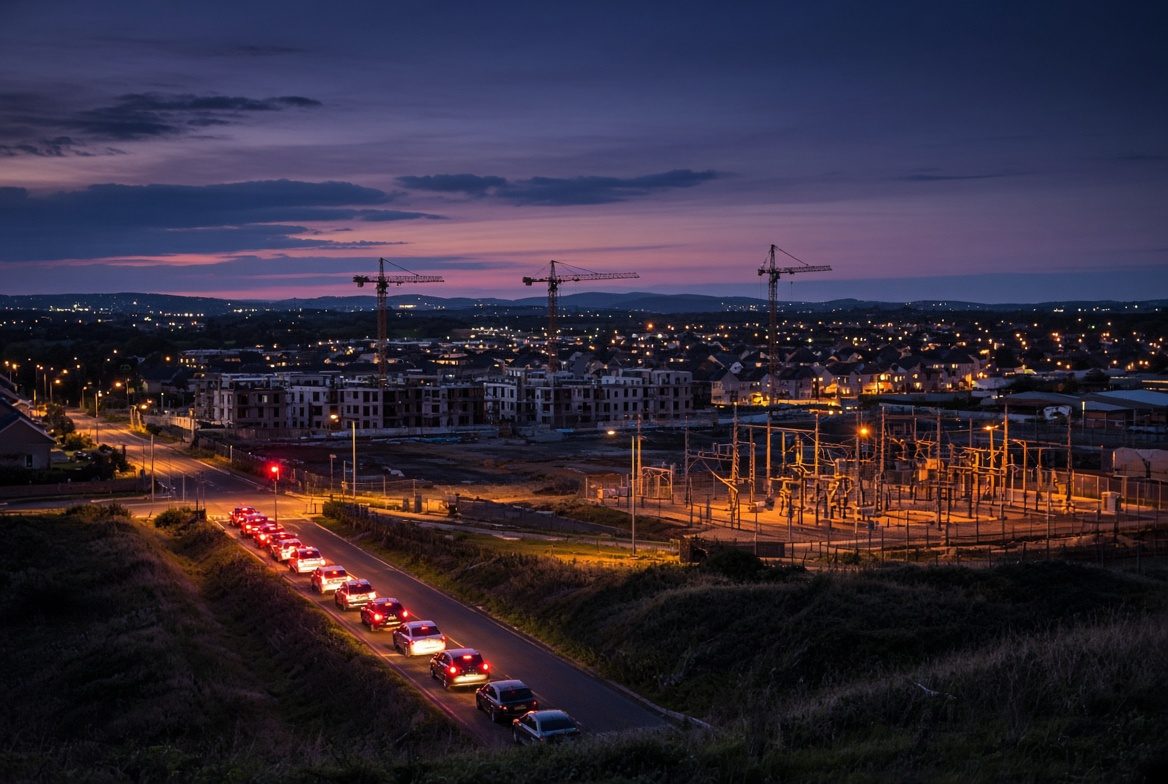
The problem statement
Three crises, one root cause
Debates about the cost of living, climate change and how our towns work are often polarised. Yet wherever you stand, three realities are hard to ignore, and they are accelerating together.
Energy affordability
Households, businesses and public services face energy costs that feel impossible to control, even when global markets settle.
Housing shortages
Land near busy roads and junctions is expensive and hard to develop, which restricts supply and pushes homes further from work.
Traffic congestion
Time, fuel and productivity are lost every day without producing anything of value. Stop-go infrastructure is a machine for destroying wealth.
These challenges are discussed as separate policy problems. In reality they are connected, and reinforced by the same underlying system.
The hidden connection
Why stop-go makes everything worse
To understand why energy feels unaffordable, we have to look beyond oil markets and pump prices. To understand congestion, we have to look beyond traffic volumes. In both cases the deeper issue is how energy is taxed, how it is wasted, and how roads are designed to destroy it.
- Energy wastedEvery stop turns kinetic energy that was already paid for into brake heat.
- Cost inflatedFuel is burned twice, time is lost, and crashes happen at the conflict points.
- Land value suppressedCongested locations become less attractive to live and build in.
- Housing constrainedDevelopment economics weaken near the junctions a town depends on.
The real cost does not begin in the oil field, the refinery or even at the pump. It begins in the repeated, deliberate destruction of momentum that towns build into their own road networks, junction by junction and crossing by crossing.
The real question is not how efficiently we recover energy after it has been destroyed. It is why we destroy it so often in the first place.
The scale
Numbers that cannot be ignored
About this series
The Momentum Papers
This is the first of fourteen papers. Each isolates one dimension of the problem or the solution: the hidden taxes at the pump, the physics of the stop, why electric vehicles do not fix it, the shockwave, the insurance cascade, the full cost, the lesson from biology, the missing policy standard, the Urban Computer and how it pays for itself, how concrete becomes a catalyst for cutting carbon, and finally why a busy junction destroys energy faster per square metre than any power station generates it.