
Glossary
The words we use across this site, in plain English. Terms underlined on our pages link here.
The basics
What a data centre does. A data centre is a building full of computers that run the internet and AI. Every search, stream, payment and AI answer is processed in one. It needs three things in large amounts: electricity, cooling and a fast network connection. Almost all of the electricity it uses ends up as heat, which is usually vented and lost.
AI has changed what data centres need. AI chips draw far more power and give off far more heat than ordinary servers, and in many places the grid cannot connect new large sites quickly. Capacity is now limited by power, not by demand.
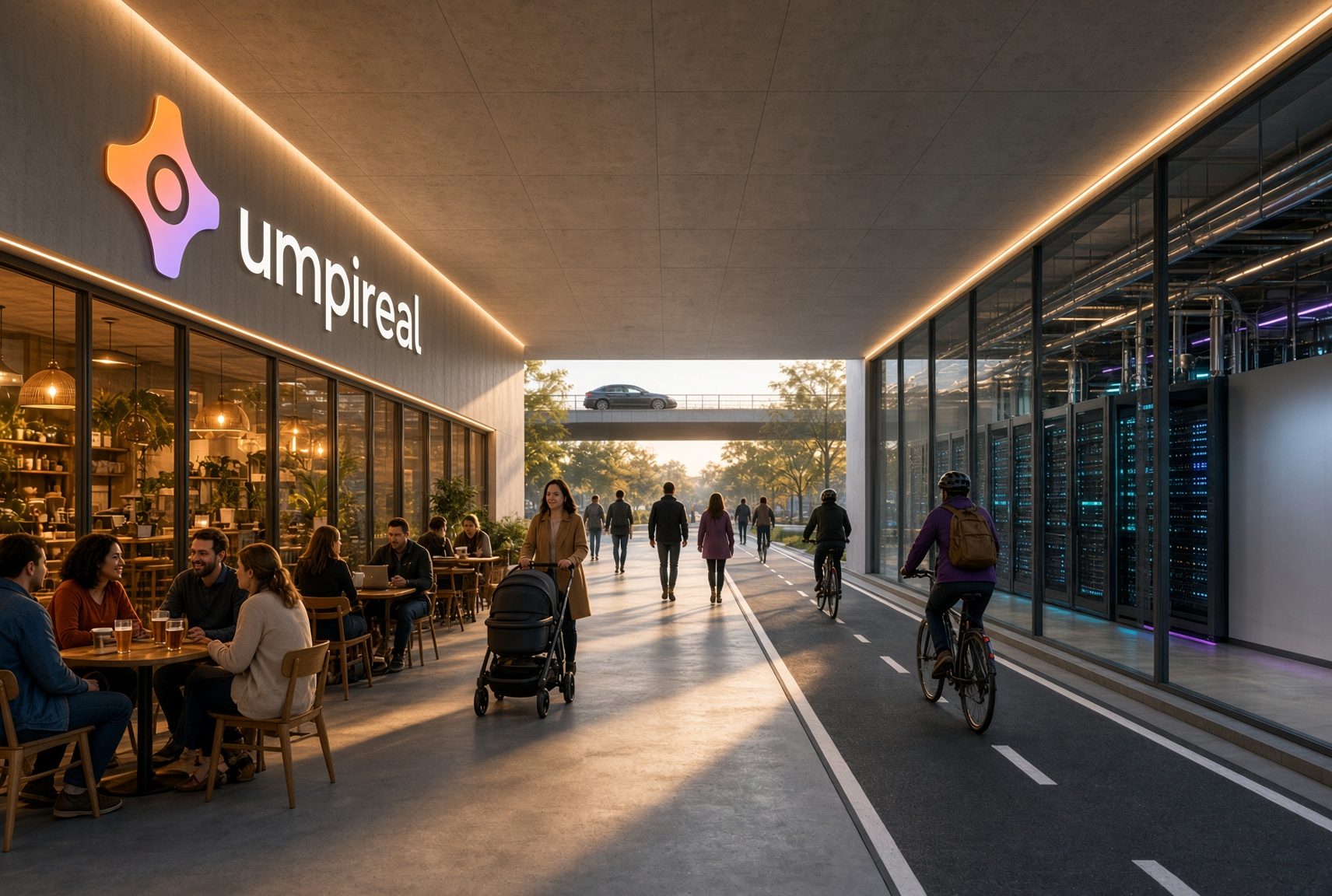
What an Urban Computer does. Umpireal Urban Computers place AI compute and battery storage in the rooms of a free-flow road junction, between the raised road and the path for people on foot and bike. The compute is rented to customers, and that income pays for a junction where traffic never has to stop. The batteries support the local grid, and heat from the computers is put to use in nearby buildings instead of being lost.
Roads and junctions
- Momentum tax
- Our name for the fuel, time and emissions spent every time a vehicle stops and then has to buy its speed back. It is paid at every set of lights, every yield and every speed bump.
- Free-flow junction
- A junction where traffic joins and leaves without stopping, because no two streams of traffic cross each other at the same level. There are no traffic lights.
- Signalised junction
- A junction controlled by traffic lights.
- Grade separation
- Putting crossing streams of traffic on different levels, such as a flyover. It removes the conflict but is usually expensive and earns no income.
- Stop-start
- A car system that switches the engine off while the car is stationary to save fuel. It saves idling, which is a small part of the energy lost at a stop.
- Regenerative braking
- Braking in an electric vehicle that turns some of the car's motion back into battery charge. Most of the energy is still lost as heat.
- Tank to wheel, well to wheel
- Two ways of counting a vehicle's energy. Tank to wheel counts only the fuel or charge the vehicle uses. Well to wheel also counts the energy spent producing and delivering that fuel or electricity.
AI and data centres
- Data centre
- A building that houses computers, with the power, cooling and network connections they need to run around the clock.
- Compute
- Computer processing power. Data centre capacity is bought and sold by the electricity it draws, so compute is measured in megawatts.
- GPU
- The specialised chip that runs most AI. Powerful, expensive, and hot.
- AI training
- Teaching an AI model by feeding it vast amounts of data. It needs enormous concentrated power and is done in large, remote campuses.
- AI inference
- Using a trained AI model to answer a question or carry out a task. It happens every time anyone uses AI, so it grows with every user, and it works best close to the people and machines using it.
- Fine-tuning
- Adapting an existing AI model to a particular business or task using that organisation's own data.
- AI agents (agentic AI)
- AI that carries out tasks on its own, such as booking, ordering or running systems, rather than only answering questions. Agents work continuously in the background, which multiplies the demand for inference.
- Frontier AI
- The most advanced AI models, built by a small number of labs. Training them needs the largest campuses in the world. Urban Computers are built for serving AI, not frontier training.
- Sovereign capacity
- Compute that keeps data and AI processing inside a country or region, under its own laws.
- Colocation
- Renting space, power, cooling and connectivity to customers who install their own computers.
- HaaS (Hardware as a Service)
- The customer rents the computers as well as the space they sit in.
- Hyperscale, hyperscaler
- The very largest data centres, and the global cloud companies that run them.
- Neocloud
- A newer cloud company built specifically to rent out GPU capacity for AI. Neoclouds are among the fastest-growing buyers of data centre space.
- Edge computing
- Processing data close to where it is created or used, instead of in a distant facility.
- Latency
- The delay between a request and its answer. Distance adds latency.
- Direct liquid-to-chip cooling
- Cooling that carries heat away from each chip in liquid through a sealed loop. No water is used up, and the heat comes out warm enough to use in buildings.
Energy and the grid
- MW (megawatt)
- A measure of power: how much electricity something draws at any moment. One megawatt is a million watts. Data centres are sized in megawatts.
- MWh, GWh, TWh
- Measures of energy: power used over time. One MWh is one megawatt for one hour. A GWh is a thousand MWh, and a TWh is a million MWh.
- Battery storage (BESS)
- A battery energy storage system holds electricity so it can be used when it is needed most, and helps keep the grid stable.
- Grid connection queue
- The waiting list for a new connection to the electricity network. In many places new large sites wait years.
- Grid constraint
- When the local electricity network cannot take more demand or more generation without being upgraded.
- Curtailment
- Turning down wind or solar generation because the grid cannot take the power at that moment, so clean electricity goes unused.
- Evening peak
- The time of day when electricity demand is highest, as people come home and solar output falls.
Building and carbon
- Precast
- Concrete sections made in a factory and delivered to site ready to install, rather than poured in place.
- Embodied carbon
- The carbon emitted in making and building something, before it is ever used.
- Prevented energy
- Energy that is never used because the waste is stopped at its source. We report it as its own line, never netted against what a node consumes.
- Wayleave
- Permission to place infrastructure on land owned by someone else, here the road authority.
- TRL 9
- Technology Readiness Level 9, the top of the standard scale: technology proven in real, everyday operation.
Company and investment
- Patent application
- A formal request for patent protection, filed and pending examination. Ours is IE 2025/0540.
- PCT application
- An application under the Patent Cooperation Treaty, one international filing that keeps open the option of seeking protection in many countries.
- NVIDIA Inception
- NVIDIA's programme supporting startups working with AI.
- Concession
- An agreement where a private operator builds and runs an asset for a public body for a set period.
- Ground rent
- A regular payment to the landowner for the use of their land.
- Net operating income
- Income from an asset after its running costs, before financing and tax.
- Seed round
- An early investment round that funds a company's first major steps, here the first live node.