
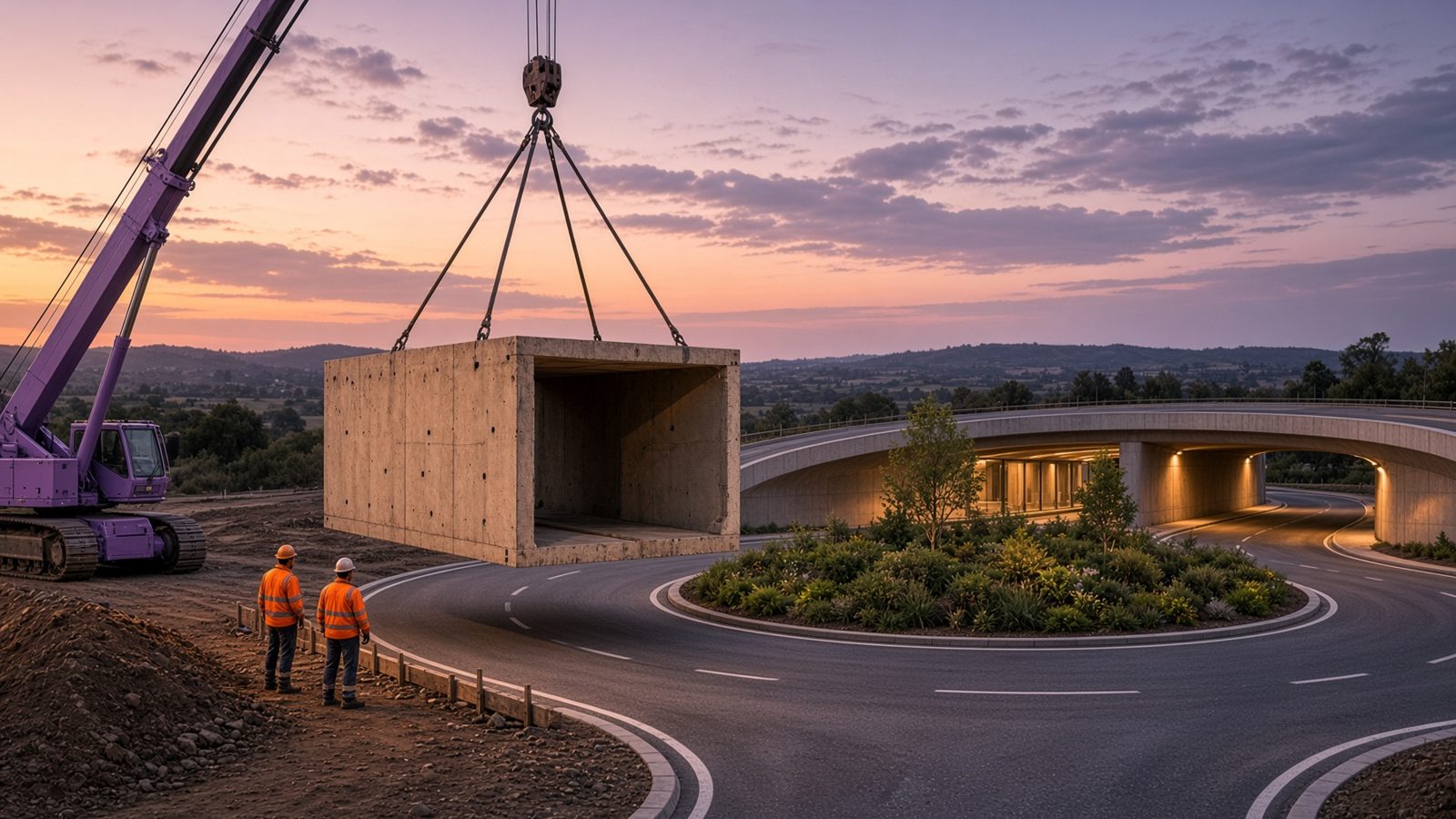
The paradox
The most-used material, and the most criticised
Concrete is the most widely used man-made material on earth, and making its cement is responsible for around 8% of global CO₂ emissions. That is why the construction industry is under pressure to use less of it.
But the right question is not only how much carbon a tonne of concrete costs. It is what that carbon buys. Most concrete is spent on structures that never pay their carbon back. A free-flow junction does, and quickly.
Carbon payback
Weeks to pay back. A century of return.
Every building carries embodied carbon from its materials and construction. Most never repay it; they simply add to the total. An Urban Computer is different, because removing the stop at a busy junction prevents around 3,000 tonnes of CO₂ a year from the vehicles that no longer have to brake and restart.
At that rate, the roughly 300 tonnes embodied in the precast shell is paid back in about five weeks. At today’s traffic and fuel mix, over a 100-year design life, the same shell would prevent in the region of 300,000 tonnes: about a thousand times the carbon it took to make. As vehicles electrify the yearly figure will fall, but the energy saved by not stopping remains.
Why precast concrete
The right material for a century-long job
Built once, lasts a century
The shell is designed for a 100-year life. The compute and batteries inside are refreshed as technology moves on, while the structure stays, so its carbon is spent once rather than every 20 to 40 years as a conventional data centre building is replaced.
Standard road products
The shell is made from precast culvert units, products road contractors already install every day, so no new materials or methods are needed.
Factory precision
Precast units are made under controlled conditions, with less waste than casting on site and faster installation on the road.
Lower-carbon mixes
Cement replacements such as ground granulated blast-furnace slag can cut the embodied carbon further, specified to suit each site.
Local supply
Quarries and precast works serve almost every region, keeping haulage distances and transport emissions short.
Slowly reabsorbs CO₂
Over its life, exposed concrete reabsorbs some CO₂ from the air through carbonation, offsetting a share of the emissions from making its cement.
The catalyst
Concrete as the enabler
Without the shell, there is no raised road, no free-flow junction, no daylit crossing beneath it and no Innerspace for the compute that pays for it all. A modest, one-off carbon cost unlocks a century of prevented emissions, safer streets and digital infrastructure the town can use.
Concrete as usual
- Embodied carbon that is never repaid
- Structures that end their life as a cost
- Rebuilt every few decades
- A climate liability
Concrete as catalyst
- Embodied carbon repaid in about five weeks
- A structure that earns its keep through compute
- Built once for a 100-year life
- A climate asset
The question is not whether we use concrete. It is whether each tonne of it prevents more carbon than it costs.